How to Write Design Case Studies That Get You Hired
DESIGN

There’s a quote from David "Allen’s Getting Things Done" that I keep coming back to every few months:
“Your mind is for having ideas, not holding them.”
The same applies to your design work. You did the thinking. You solved the problem. You made the thing. Now you have to get it out of your head and onto the page, and that’s where most designers completely freeze.
Case studies are that moment. And yeah, they’re the most dreaded part of building a portfolio. But here’s the truth: they’re also the most important part. More important than your logo. More important than your colour palette. More important than whether you’re on Behance, Semplice, or some custom-coded site.
A case study is where you stop being a gallery and start being a designer people actually want to hire.
Write it before you’re sick of the project

This is the advice nobody wants to hear. Write your case study notes during the project, not after.
By the time you’re ready to launch your portfolio, you’re exhausted and you just want to hit publish. Anything you write at that point will be rushed. Or worse: you’ll hit a wall and delay the whole thing indefinitely.
So start a Google Doc early. Think in phases. Phase 1: ideation. Phase 2: development. Phase 3: final execution. Jot down your thinking as you go. Don’t worry about images yet, don’t worry about formatting. Just get the thoughts out of your head and somewhere you can find them.
You’ll thank yourself later. Every single time.
Keep it short. Caption everything
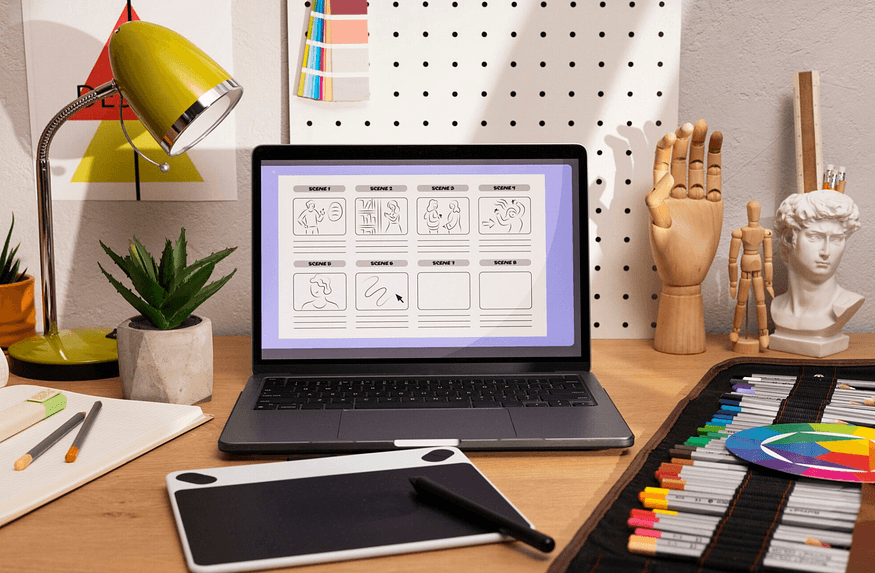
Nobody is reading your case study like a novel. They’re scanning it. They’re trying to answer one question as fast as possible: does this person know what they’re doing?
Here’s a trick: write your captions first. One or two sentences under every image. If someone scrolls your entire case study and only reads those, they should still understand the project. That’s your baseline. Then go back and fill in the longer sections.
Short paragraphs. Plain language. No jargon. No buzzwords.
Daniel Kahneman talks in Thinking Fast and Slow about how our minds constantly swap out hard questions for easier ones. Your reader’s brain is doing this the whole time they’re on your portfolio. Make it easy for them to land on the right answer.
Follow this structure (but make it yours)
You don’t need to reinvent the wheel. A good case study follows a simple arc:
1. Project overview: Who’s the client? What do they do? What were you asked to solve? Give people context fast.
2. The challenge: What was the actual problem? What were the constraints? This is what sets the stakes.
3. Your process: This is the part most designers skip, and it’s the most important. Show your sketches. Show your dead ends. Explain why you made the decisions you made. Ask yourself WHY a thousand times and then answer it.
4. The solution: Show the final work. Use mockups. But don’t just drop images — explain why it works.
5. What you learned: Did it exceed expectations? What would you do differently? A little honesty here goes a long way. It shows maturity, not weakness.
Give credit where it’s due

If it was a team project, say so. And say what you specifically did.
“Art direction & design.” “UX research and wireframing.” “Brand identity only.” Simple as that.
Skipping this detail can cost you the job. A recruiter (often not a designer themselves) has no way of knowing what you contributed if you don’t tell them. Don’t make them guess.
Write like a human being

Don’t copy and paste your client’s website copy into your case study. Everyone can tell when you do this. The voice shifts completely and it makes you look lazy.
Don’t try to sound impressive. Sound like yourself.
Christopher Voss, the former FBI negotiator who wrote Never Split the Difference, talks about how the goal of communication isn’t to sound smart, it’s to make the other person feel heard and understood. Your case study reader wants to understand who you are and how you work. Give them that.
Write it like you’re explaining the project to a friend over coffee.
Treat it like a magazine feature

Think about how magazine articles are designed. The photos illustrate specific points. Pull quotes draw your eye. The layout creates an experience, not just a sequence of images.
Your case study should do the same thing. Mix text and visuals intentionally. Don’t dump ten screenshots at the bottom and call it done. No copy means no context — and no context means no job offer.
Platforms like Behance make this easier than it used to be. Image and text blocks side by side, video support, GIF support, tool tags, custom covers. Use all of it. It’s built exactly for this.
One last thing
Pick one project you’re proud of. Right now. Could be a student project, a freelance job, a personal concept you built for fun.
Follow the structure. Write it like a person. Keep it honest.
Your portfolio isn’t a gallery. It’s a conversation starter. And case studies are where that conversation actually begins.
Now go write the thing.
Looking to start a project or you need consultation first? Feel free to contact me.